Most people think burnout happens because someone works too hard.
I don’t buy it.
I’ve met people working eighty-hour weeks who are energized and alive.
I’ve also met people working forty hours a week who feel completely disconnected from themselves.
The difference isn’t workload.
The difference is alignment.
Over the past several years, I’ve become increasingly interested in what happens when high performers begin drifting away from themselves.
First responders.
Military personnel.
Business owners.
Executives.
High Performers.
Leaders.
People who carry responsibility.
People who solve problems.
People who keep moving when everyone else stops.
I’ve started calling this Operator Syndrome.
Operator Syndrome isn’t a diagnosis.
It’s a pattern.
It’s what happens when the traits that make someone successful slowly become the traits that begin to work against them.
The operator keeps pushing.
Keeps carrying.
Keeps producing.
Keeps showing up.
Until one day they realize they’ve become highly effective at everything except listening to themselves.
When I look at people caught in that cycle, I usually see five things disappearing long before the crisis arrives.
1. Focus
Operators rarely fail because they don’t care.
They fail because they care about too many things at once.
Every opportunity looks possible.
Every problem looks solvable.
Every responsibility feels important.
The result is scattered energy.
The operator becomes busy but ineffective.
Movement replaces progress.
Activity replaces direction.
The question isn’t:
“What can I add?”
The question is:
“What deserves my attention right now?”
Focus isn’t about doing more.
Focus is deciding what matters enough to ignore everything else.
2. Foundation
Everyone wants growth.
Nobody wants maintenance.
Then life floods the house.
Sometimes literally.
Foundations aren’t exciting.
Sleep isn’t exciting.
Health isn’t exciting.
Marriage isn’t exciting.
Personal finances aren’t exciting.
Yet every meaningful achievement sits on top of those things.
When foundations weaken, operators usually respond by pushing harder.
That works for a while.
Until it doesn’t.
You can’t outwork a broken foundation forever.
At some point the cracks demand attention.
The strongest leaders I know don’t just build success.
They protect the systems that support success.
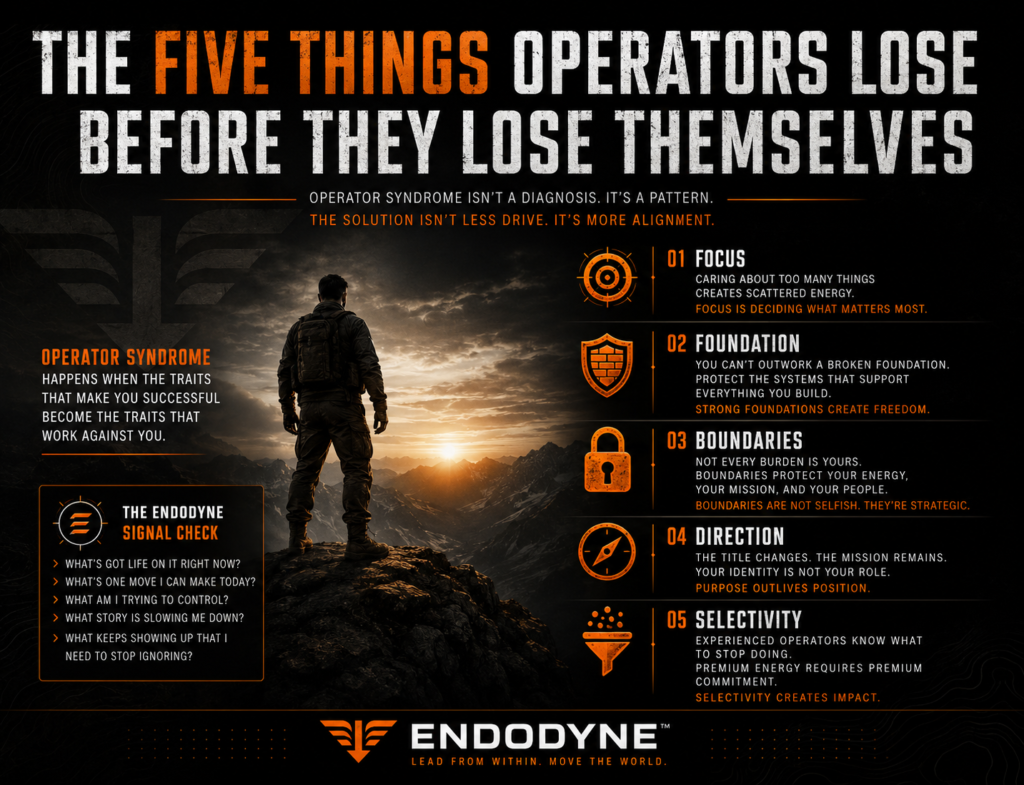
3. Boundaries
Many operators become successful because they say yes.
They help.
They rescue.
They solve.
They sacrifice.
Then they wake up carrying responsibilities that were never theirs to begin with.
One of the hardest lessons in leadership is understanding that not every burden belongs on your back.
Not every emergency is your emergency.
Not every problem requires your involvement.
Not every person deserves unlimited access to your time and energy.
Boundaries are not selfish.
Boundaries protect the mission.
Without boundaries, operators slowly become overwhelmed by obligations that have nothing to do with their purpose.
4. Direction
This may be the biggest challenge facing successful people.
Most people know what they’re doing.
Far fewer know why they’re doing it.
A career becomes an identity.
A title becomes a personality.
A role becomes a prison.
Then something changes.
Retirement.
Divorce.
A business failure.
An injury.
A transition.
A setback.
Suddenly the question appears:
Who am I without the uniform, the title, the company, or the role?
That’s where many operators get stuck.
They know how to perform.
They don’t know how to transition.
Direction comes from understanding that your mission is bigger than your title.
The title changes.
The mission remains.
5. Selectivity
Young operators ask:
“What else can I do?”
Experienced operators ask:
“What should I stop doing?”
This is where wisdom begins.
You don’t build a great life by saying yes to everything.
You build a great life by becoming selective.
Selective with opportunities.
Selective with clients.
Selective with relationships.
Selective with commitments.
Selective with where you spend your energy.
One lesson keeps showing up in my own life:
Stop spending premium energy on people who haven’t made a premium commitment.
That applies to business.
It applies to leadership.
It applies to personal growth.
The people who create extraordinary results usually share a common trait.
They take ownership.
They execute.
They value accountability.
They move when it’s time to move.
The Real Cost of Operator Syndrome
Operator Syndrome isn’t about weakness.
It’s usually the result of strength that has gone unmanaged.
The same drive that creates success can create exhaustion.
The same responsibility that builds trust can create burden.
The same resilience that helps someone survive can prevent them from recognizing when something needs to change.
That’s why I believe the solution isn’t becoming less driven.
The solution is becoming more aligned.
Focus.
Foundation.
Boundaries.
Direction.
Selectivity.
Those aren’t soft skills.
They’re survival skills.
They’re leadership skills.
They’re the difference between building a life and simply enduring one.
The Endodyne Signal Check asks five simple questions:
What’s got life on it right now?
What’s one move I can make today?
What am I trying to control?
What story is slowing me down?
What keeps showing up that I need to stop ignoring?
The answers often reveal more than we expect.
Because the truth is this:
Most operators aren’t lost.
They’re overloaded.
And sometimes the next breakthrough doesn’t come from adding something new.
Sometimes it comes from finally letting go of what no longer belongs.
